
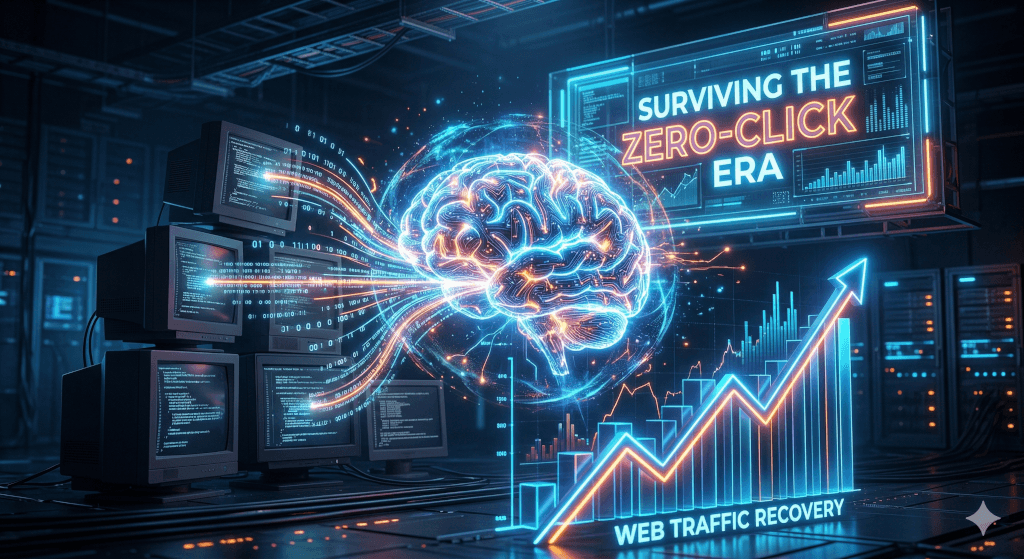
If you have checked your website analytics recently and felt a cold sweat forming, you are not alone. Across the internet, bloggers, publishers, and businesses are noticing a disturbing trend. They are seeing a sudden, inexplicable drop in organic search traffic.
You have not been penalized by Google. Furthermore, your SEO is not broken. You are simply experiencing the reality of the AI-first internet.
With the mass integration of generative AI tools, the way humans browse the web has fundamentally changed. Consequently, we have entered the Zero-Click Era.
The Anatomy of the AI Web Traffic Drop
For two decades, the internet operated on a simple transaction. A user asks a question, a search engine provides a list of links, and the user clicks on a website to find the answer.
However, generative AI has severed that transaction entirely. Today, when a user asks, “How do I fix a leaky faucet?” an AI synthesizes data from dozens of websites. It then presents a perfect, formatted answer right at the top of the screen.
The user gets exactly what they need immediately. The problem? They never click on your website.
Informational content—the traditional bread and butter of blogging—is being decimated. If your website exists solely to answer basic, objective questions, AI has effectively automated your niche.
But this is not the end of the web. It is simply an evolution. To survive and thrive, website owners must stop trying to out-summarize AI. Instead, they must start offering what AI cannot.
How to Increase Web Traffic in an AI-Dominated Landscape
To win back your visitors, you must pivot. You must move from providing generic information to providing unique human experiences. Here is a detailed roadmap to future-proof your website traffic.
1. Shift to “Information Gain”
AI models are trained on the past. They can only regurgitate what already exists. Therefore, your biggest advantage is creating Information Gain—content that adds completely new insights, data, or perspectives to the internet.
- Publish Original Research: Stop writing generic lists based on other people’s articles. Instead, conduct a survey, run a 30-day experiment, or scrape a dataset to find unique trends. If you are the original source of new data, both AI models and humans must cite you.
- Share Hands-On Experience: AI does not have hands. It cannot test a new mechanical keyboard, and it cannot share the frustration of a buggy line of code. Inject personal anecdotes, case studies, and subjective opinions into your writing.
2. Build “Moats” with Interactive Content
An AI can write a paragraph explaining how compound interest works. However, it cannot be a compound interest calculator.
To give users a reason to actually visit your domain, turn your static blog posts into interactive resources.
- Embed Interactive Tools: Add lightweight JavaScript calculators, quizzes, or dynamic infographics directly to your pages.
- Offer Tangible Assets: Give away downloadable resources. Whether it is a custom spreadsheet, a Lightroom preset, or a snippet of code, require users to visit your site to claim the asset.
3. Cultivate Direct Traffic
Relying entirely on search engine algorithms is no longer a viable business model. You need to “own” your audience so you can reach them regardless of search updates.
- Start a High-Value Newsletter: Capture your visitors’ email addresses by offering a strong lead magnet. When you publish a new article, you can send it directly to your subscribers. This generates guaranteed traffic without relying on search rankings.
- Build a Community: Add a forum, start a Discord server, or build a dedicated group linked to your brand. When people feel like they belong to a community, they will type your URL directly into their browser.
4. Optimize for “Human SEO”
Search engines are aggressively prioritizing content written by verified experts. This is their way of combating the flood of AI-generated spam. Therefore, you need to prove your humanity by demonstrating E-E-A-T (Experience, Expertise, Authoritativeness, and Trustworthiness).
- Demonstrate Clear Expertise: Make sure your author bio highlights your real-world credentials. Are you a certified developer or a professional chef? Make it obvious to the reader.
- Target the “Long-Tail of Friction”: AI is great at broad topics but struggles with highly specific, complex problems. Instead of writing “How to start a garden,” write “How to revive wilted tomato plants in clay soil during a heatwave.”
5. Adapt to Generative Engine Optimization
Generative Engine Optimization (GEO) is the new SEO. Even if users are not clicking standard links, AI chatbots still cite their sources.
- Ensure your site uses clear, semantic HTML.
- Incorporate easily extractable quotes, distinct statistics, and clear definitions. An AI bot can easily scrape these and reference them in its answers, resulting in a direct citation link back to your website.
The Bottom Line
The era of effortless traffic from basic informational blogs is over. However, the websites that will dominate the next decade are the ones that lean heavily into human connection, original research, and interactive utility.
Stop trying to be an encyclopedia, because AI is already a better one. Start being an expert, an entertainer, and a toolmaker. If you do this, your traffic will not only return, but it will be more engaged than ever before.


Leave a Reply