
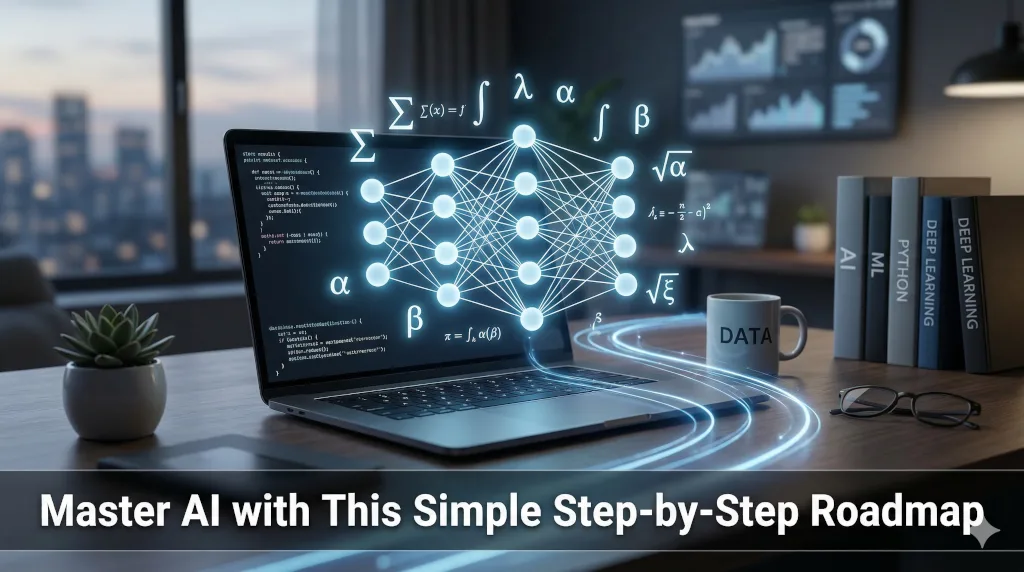
AI is no longer just a buzzword; it’s the electricity of the 21st century. Like many of you, I spent months watching incredible demos of ChatGPT and Midjourney, wondering how it all actually works. Recently, I decided to stop being just a spectator and start being a creator.
But here’s the truth no one tells you: AI isn’t just about code—it’s about the language of logic. To truly master it, I realized I had to go back to the roots. I’ve officially started my journey into Artificial Intelligence, and I’m starting where the magic actually happens: Mathematics.
The Gold Standard: Industry Resources
Before diving into my personal routine, I want to share the “North Star” resources used by the pros. These are the best places to see how the giants of the industry teach AI.
🗺️ Official Roadmaps
- Roadmap.sh – AI Engineer Roadmap: The most comprehensive visual guide for becoming a modern AI engineer.
- Google’s Generative AI Learning Path: A curated set of courses from Google experts.
- Microsoft’s AI Learning Path: Perfect for understanding AI in enterprise environments.
📺 All-in-One Learning (YouTube)
- Andrej Karpathy – Let’s build GPT: The gold standard for understanding the technical roots of AI.
- FreeCodeCamp – AI & Machine Learning Full Course: A massive, 12-hour comprehensive guide for deep learners.
✍️ Research Blogs to Follow
- OpenAI Blog: Updates directly from the creators of ChatGPT.
- Google DeepMind Blog: Deep dives into the science of frontier AI.
- NVIDIA Blog: Infrastructure and hardware insights.
My 5-Phase AI Roadmap
Don’t get overwhelmed. Transitioning into AI can feel like drinking from a firehose, but it becomes manageable when you break it down into logical blocks. Here is the exact, deep-dive path I am following to go from zero to AI hero.
Phase 1: Foundations of Mathematics 📍 (I am here!)
This is the most critical stage, yet the one most people skip. If you don’t understand the math, you’re just “guessing” with code.
- Linear Algebra: This is how AI represents data. We learn about vectors and matrices, which are the building blocks of neural networks. Understanding matrix multiplication is key to knowing how data flows through a model. We also dive into Eigenvectors and Eigenvalues, which help in dimensionality reduction (making big data smaller without losing meaning).
- Calculus: Specifically, we focus on Multivariable Calculus and Partial Derivatives. Why? Because of Backpropagation. AI learns by calculating the “error” of its guess and moving “downhill” to minimize that error. Calculus provides the “slope” to find that path.
- Probability & Statistics: AI is essentially a giant prediction engine. You need to understand Probability Distributions (Normal, Gaussian, etc.) to know how likely a result is. We also cover Bayesian Statistics, which allows models to update their “beliefs” as more data comes in.
Phase 2: Python & Data Libraries
Once the math makes sense, it’s time to translate it into a language computers understand. Python is the undisputed king of AI because of its incredible ecosystem.
- NumPy: This is the library for numerical computing. It allows us to perform high-speed mathematical operations on those matrices we learned about in Phase 1.
- Pandas: Data is messy. Pandas is the tool we use for Data Wrangling. We learn how to clean datasets, handle missing values, and transform “raw data” into a format that a machine can actually learn from.
- Matplotlib & Seaborn: You cannot improve what you cannot see. Data Visualization is vital for finding patterns, spotting outliers, and communicating results to stakeholders. We learn how to turn thousands of rows of numbers into meaningful graphs.
Phase 3: Classical Machine Learning
Before jumping into “Deep Learning,” you must master the classics. These are the algorithms that run most of the world’s current software.
- Supervised Learning: This is where we train models on labeled data. We cover Linear and Logistic Regression for simple predictions, and Decision Trees and Random Forests for more complex logic.
- Unsupervised Learning: Here, the machine finds patterns on its own. We learn Clustering (K-Means) to group similar customers together and Principal Component Analysis (PCA) to simplify complex data.
- Evaluation Metrics: How do we know if a model is good? We dive into Precision, Recall, F1-Score, and the Bias-Variance Tradeoff. This ensures our models work in the real world, not just on our laptops.
Phase 4: Deep Learning & Neural Networks
This is where things get “human-like.” We move from simple algorithms to complex architectures inspired by the human brain.
- Artificial Neural Networks (ANNs): We learn how layers of “neurons” process information. We study Activation Functions (like ReLU and Sigmoid) that determine which information is important enough to pass forward.
- Convolutional Neural Networks (CNNs): The secret behind computer vision. We learn how AI can “see” images by identifying edges, shapes, and eventually complex objects like faces or cars.
- Recurrent Neural Networks (RNNs): Used for sequential data like speech or stock prices. We explore LSTMs (Long Short-Term Memory) which allow models to “remember” previous information in a sequence.
- Frameworks: We choose our weapon—PyTorch or TensorFlow. I am leaning toward PyTorch for its flexibility and popularity in the research community.
Phase 5: Generative AI & LLMs
The final frontier. This is where we build the “magic” apps that generate text, images, and code.
- The Transformer Architecture: This is the “big bang” moment of modern AI. We study Self-Attention mechanisms, which allow a model to focus on the most relevant parts of a sentence regardless of how far apart the words are.
- Large Language Models (LLMs): We learn how to work with models like GPT-4 or Claude. This includes Fine-tuning (training a pre-built model on your specific data) and Prompt Engineering (the art of talking to AI).
- Retrieval-Augmented Generation (RAG): One of the hottest skills right now. We learn how to connect an LLM to a private database so it can answer questions about your specific documents without “hallucinating.”
- Ethics & Alignment: As we build these powerful tools, we must study AI Ethics. How do we ensure these models are unbiased, safe, and helpful to humanity?
🎓 Why I’m Starting with Math (The Udemy Deep Dive)
I am currently enrolled in the Mathematics-Basics to Advanced for Data Science and ML course on Udemy, and it’s been a game-changer.
Instead of dry formulas, this course focuses on “Intuitive Learning.” It doesn’t just ask you to memorize equations; it shows you how those equations translate into the code that makes a self-driving car stay on the road or a Netflix recommendation feel personalized.
What’s Under the Hood?
- Linear Algebra: Understanding how AI “sees” data through vectors and matrices.
- Calculus: Learning how models “learn” and optimize themselves through gradient descent.
- Probability & Statistics: The secret sauce behind AI making confident predictions.
Meet the Instructor: Krish Naik
A huge reason this course works is the lead instructor, Krish Naik. He is a highly respected Data Scientist and a pioneer in AI education with over a decade of industry experience. Known for his popular YouTube channel and his work with iNeuron, Krish has a unique talent for explaining complex mathematical proofs in a way that is easy to visualize and apply to actual Python code. He bridges the gap between “academic math” and “industry application.”
What other learners say: “With a 4.5-star rating, students love how this course clears years of confusion in just a few modules. It is highly recommended for anyone who feels stuck on the theory.”
👋 Learn Along With Me!
I don’t want to do this alone. AI is a collaborative field, and the best way to learn is by teaching and sharing. If you’ve been waiting for a sign to start your AI journey, this is it. I’m inviting you to grab this course and tackle the math modules alongside me. We can share our notes, struggle through the equations together, and celebrate those “Aha!” moments when the logic finally clicks. We aren’t just learning a skill; we are future-proofing our careers.
Are you in? Let me know in the comments if you’re joining the “Math-First” movement! Let’s build the future, one derivative at a time.
Leave a Reply