
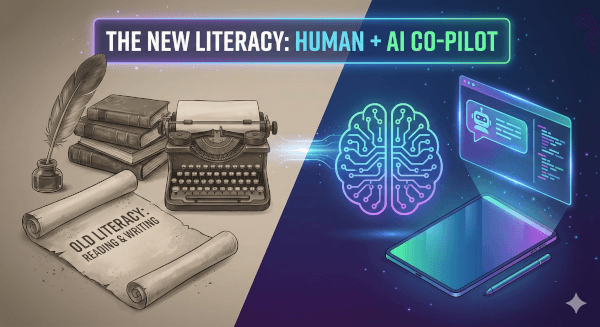
Remember when putting “proficient in Microsoft Word” on a resume was a flex? Today, it’s an assumed baseline skill. If you can’t use a word processor, you can’t function in a modern office.
We are standing at another one of those historical inflection points right now.
Artificial Intelligence—specifically generative AI like ChatGPT, Claude, and Midjourney—is not just another tech trend that will fade away like NFTs. It is a fundamental shift in how we work, create, and solve problems. It is the printing press, the steam engine, and the internet rolled into one.
And just like reading and writing became essential skills in the past centuries, AI Literacy is becoming the foundational skill of the 21st century.
In 2025, knowing how to effectively work with AI isn’t a “bonus skill”—it’s a basic requirement for staying relevant.
What “AI Literacy” Actually Means (And What It Doesn’t)
When people hear “AI Literacy,” they often panic, thinking they need to go back to school to learn Python or understand complex neural networks.
Relax. That’s not it at all.
You don’t need to know how to build a car engine to be a good driver. Similarly, you don’t need to be a machine learning engineer to be AI literate.
AI literacy is simply the ability to understand, use, and critically evaluate AI tools. It boils down to three core pillars:
- Understanding Capabilities vs. Limitations: Knowing what AI is incredibly good at (summarizing, brainstorming, pattern recognition) and what it is terrible at (fact-checking, genuine empathy, highly specific domain knowledge).
- The Art of the Prompt: Learning how to “speak” to the AI. This is the new coding. The quality of the output depends almost entirely on the quality of your input.
- Critical Thinking & Skepticism: This is the most important one. AI models can be confidently wrong. Being literate means never trusting an AI’s output blindly. You must be the editor, the fact-checker, and the final decision-maker.
It’s important to understand where we are with this technology. We are currently navigating a noisy landscape of hype and reality. Being literate means knowing how to see past the inflated expectations to find real-world value.
The “Co-Pilot” Mindset: From Fear to Empowerment
The biggest blocker to AI literacy isn’t technical difficulty; it’s fear. The headline “AI Will Take Your Job” is terrifying.
Let’s reframe that. AI won’t replace you. A person using AI will replace you.
Think of AI not as a replacement, but as the ultimate co-pilot.
- For a Writer: It’s not writing the final book. It’s the research assistant that pulls together disparate facts, the brainstorming partner that suggests 20 title ideas in seconds, and the editor that catches clunky phrasing.
- For a Programmer: It’s not architecting the entire system. It’s the junior developer that writes the boilerplate code, writes the unit tests, and helps debug an obscure error message.
- For a Marketer: It’s not creating the entire campaign strategy. It’s generating dozens of ad copy variations for A/B testing and analyzing customer sentiment from thousands of reviews.
In every scenario, the human is still the pilot. You set the destination, you make the judgment calls, and you add the unique human touch that a machine can’t replicate. AI just helps you fly faster and smoother.
Your First 3 Steps to AI Literacy
If you feel behind, don’t worry. The best part about this revolution is that the barrier to entry is incredibly low. You can start today.
Here are three simple steps to begin your journey:
1. Stop treating it like Google.
When you use a search engine, you throw keywords at it and hope for the best. With AI, you need to have a conversation. Give it context. Give it a persona. Tell it how you want the answer formatted.
- Bad Prompt: “How to write a blog post.”
- Better Prompt: “You are an expert content marketer. Outline a blog post for beginners about the importance of AI literacy. The tone should be encouraging and professional.”
2. Automate one mundane task this week.
Don’t try to build a complex app. Pick something small and annoying that you do every day.
- Need to write a difficult email? Ask ChatGPT to draft it for you.
- Have a long PDF report to read? Ask an AI tool to summarize the five key takeaways.
- Stuck on a blank page? Ask for ten creative ideas to get started.
3. Commit to continuous learning.
The field is moving too fast for any single textbook to keep up. The best way to learn is to stay curious and keep experimenting. That’s exactly what this blog is for—to be your guide as we figure this out together.
The future doesn’t belong to the people who can build the best AI models. It belongs to the people who know how to use them best. Welcome to the new literacy.
Leave a Reply